









Signal Isolator
A signal isolator is a signal isolation device used between field instruments and the control room in industrial environments. It transfers useful signals while cutting off harmful interference paths, protecting key equipment, and resolving “communication barriers” between different devices.
1. Eliminating Ground Loop Interference
In complex industrial environments, instruments, PLCs, and DCS units may be distributed in different locations with different grounding points. Due to inconsistent ground potentials, a “ground potential difference” is formed, which generates additional current in the signal line—known as a ground loop current. This current superimposes onto the useful signal and causes distortion, such as signal drift, jumping, or instability.
The signal isolator uses optical or electromagnetic isolation to isolate input, output, and power, eliminating direct electrical connections between devices and completely removing ground loops.
2. Suppressing Electromagnetic Interference (EMI) and Surge
Industrial sites contain strong sources of electromagnetic interference (such as motors, inverters, and radio equipment), which can easily couple noise into signal lines. Lightning and power switching also create high-voltage surges. The isolator’s high isolation strength and filtering circuits effectively suppress common-mode and differential-mode interference and block high-voltage surges from reaching sensitive devices like PLC analog input modules.
3. Protecting System Equipment
When abnormal high voltage (e.g., sensor short circuit or lightning) enters the signal line, the isolator is designed to fail first, sacrificing itself to protect expensive PLC/DCS control systems. This reduces maintenance costs and prevents system downtime.
4. Signal Conversion and Distribution
• Converts one signal type into another, e.g., converting a 4–20mA signal to 1–5V for receiving devices.
• Converts weak, nonlinear signals from thermocouples (TC) or RTDs into standard 4–20mA or 0–10V signals.
• Separates analog and digital components in HART protocol signals.
• Provides signal splitting (one input to two or more isolated outputs), allowing one 4–20mA signal to be used simultaneously by DCS and a VFD.
5. Solving Impedance Matching Issues
Some signal sources (such as certain sensors) have weak drive capability. Directly connecting them to a low-impedance load may cause signal attenuation or errors. Isolators offer high input impedance and low output impedance, ensuring proper matching and stable, accurate signal output.
These features make signal isolators essential components for improving the stability, reliability, and accuracy of industrial automation systems, especially in long-distance transmission, EMC-heavy environments, and multi-device signal distribution applications.

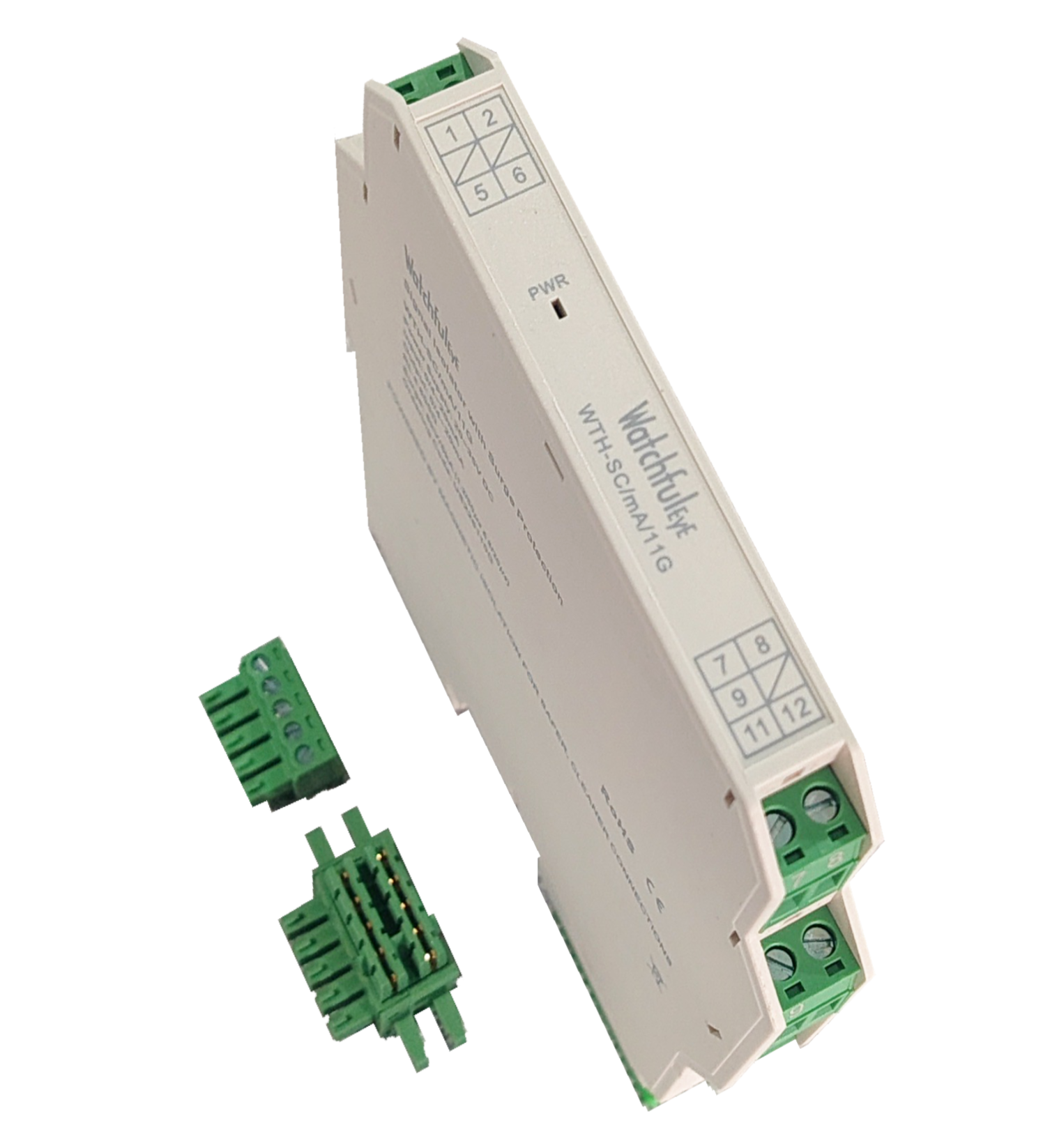
|
4-20mA Signal Isolator1. Strong anti-interference capability: Highly integrated circuitry and high-performance transformers significantly reduce external electromagnetic interference.2. High conversion accuracy: Uses electromagnetic isolation technology for efficient signal conversion with an output accuracy of 0.1% F.S. 3. Easy installation and wiring: 35 mm DIN-rail mounting with plug-in terminals for convenient installation and wiring. 4. Low power consumption and excellent heat dissipation: Low-power design and convection vent structure minimize heat generation and enhance cooling. 5. Multiple safety protection mechanisms: Includes load distribution protection, power reverse-polarity protection, power-on surge protection, and surge suppression. Learn More |